Performance Marketing Skills: 6 Skills Every Marketer Needs in 2026

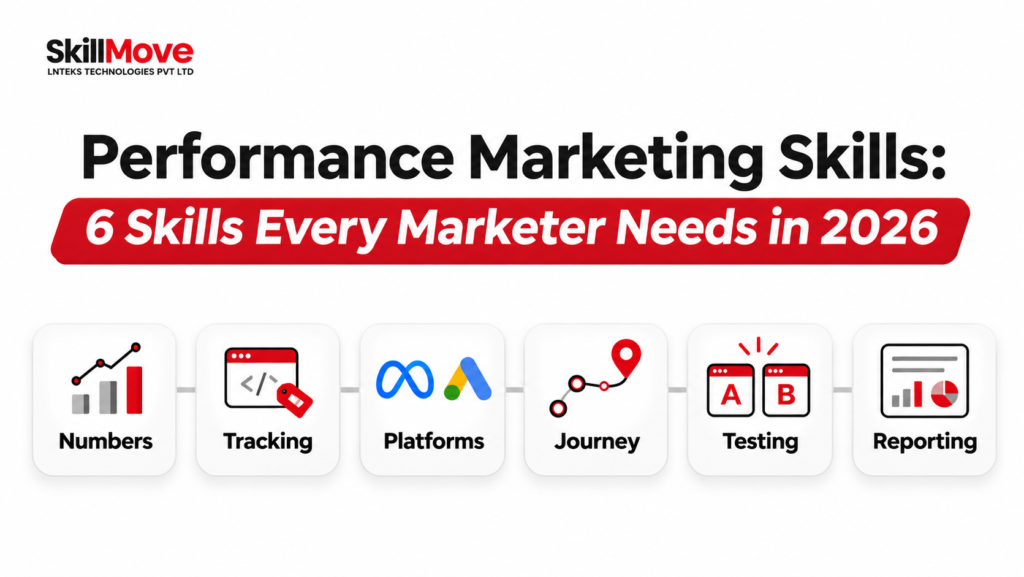
Performance marketing skills go beyond simply running ads. Employers look for six essential abilities: understanding campaign metrics (CTR, CPC, conversion rate, CPA and ROAS), setting up tracking with GA4, Google Tag Manager and Meta Pixel, managing ad platforms hands-on, understanding attribution across the customer journey, running A/B tests, and communicating campaign results clearly. Beginners can develop all six performance marketing skills through a mock campaign and a short, honest case study.
Introduction
Knowing how to launch an ad is only one part of the job. Employers hiring for performance marketing roles want people who can read data, track customer journeys, run experiments and turn insights into better decisions. Those are the performance marketing skills that separate a campaign operator from a marketer a team can trust with budget.
This guide explains the six performance marketing skills every beginner should build, which tools and official Google and Meta documentation to learn from, and how to prove each skill with a small portfolio project, even with zero experience.
What Are Performance Marketing Skills?
Performance marketing skills are the abilities needed to run paid and digital campaigns where results are measured and paid for by outcome, such as clicks, leads or sales. They combine analysis (metrics and attribution), technical setup (tracking), platform knowledge (Meta Ads Manager and Google Ads), experimentation and communication.
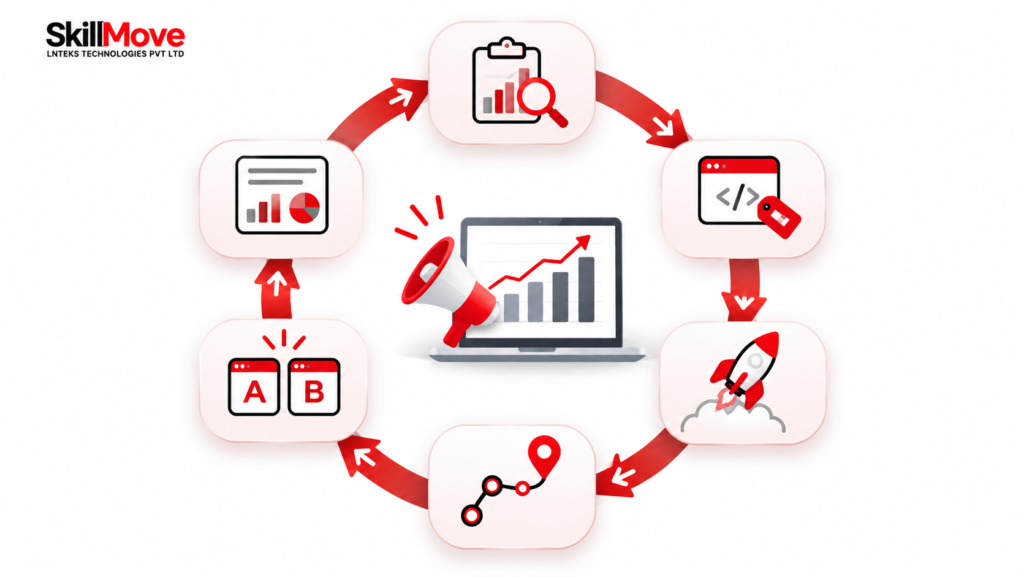
The six performance marketing skills below follow the order of a real campaign: measure, track, launch, attribute, test and report.
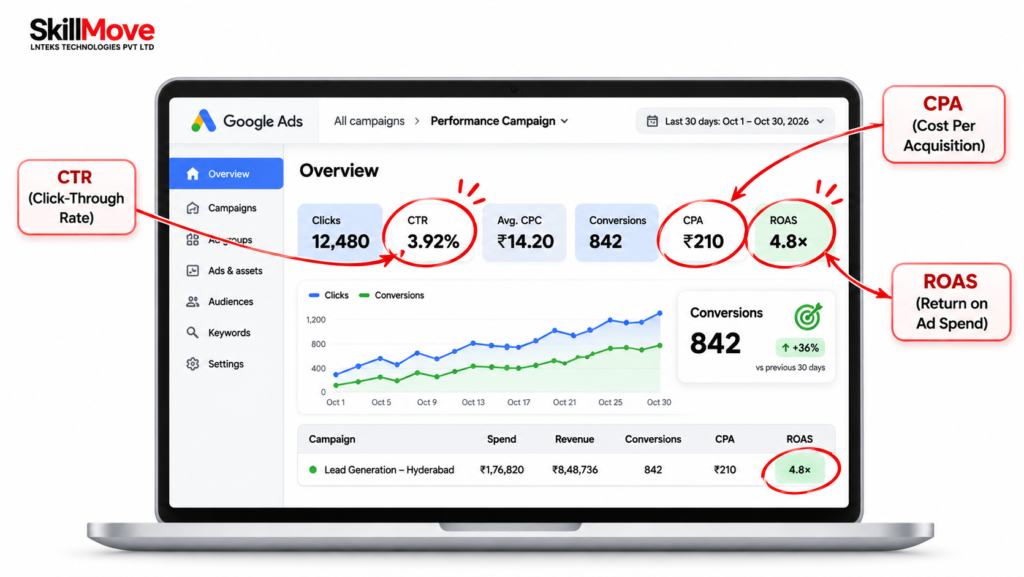
Skill 1: Read the Numbers (CTR, CPC, CVR, CPA and ROAS)
The first of the performance marketing skills is knowing what each metric tells you, and what it hides.
Key Campaign Metrics & Formulas
Understand the essential metrics used to measure advertising performance.
| Metric | Formula | What It Tells You |
|---|---|---|
| CTR (Click-through rate) |
Clicks ÷ Impressions
|
Whether the creative earns attention |
| CPC (Cost per click) |
Spend ÷ Clicks
|
How expensive traffic is |
| Conversion Rate |
Conversions ÷ Clicks
|
Whether the landing page and offer convert |
| CPA (Cost per acquisition) |
Spend ÷ Conversions
|
What one customer or lead costs |
| ROAS (Return on ad spend) |
Revenue ÷ Ad Spend
|
Revenue earned per rupee of spend |
Quick tip: Track these metrics together rather than judging a campaign using just one number.
ROAS is not profit. Suppose you spend ₹10,000 and earn ₹30,000 in revenue, a ROAS of 3.0. If your gross margin is 25%, gross profit is ₹7,500, so you lost ₹2,500 before any other cost. Break-even ROAS is 1 ÷ margin, which is 4.0 in this example. Strong performance marketing skills start with this habit of checking margin before celebrating ROAS. Our guide to reading your Meta Ads dashboard goes deeper.
Skill 2: Know How Tracking Works (GA4, GTM, Meta Pixel)
You cannot optimise what you cannot measure, so tracking is one of the core performance marketing skills.
- Google Analytics 4 (GA4): Google defines a key event as “an event that measures an action that’s particularly important to the success of your business.” Google’s help pages describe the flow as event, then key event, then conversion for Google Ads. See Events and key events.
- Google Tag Manager (GTM): a tag management system that lets you manage tags on a website without changing site code. Learn four terms: tags, triggers, variables and containers. See Google’s introduction.
- Meta Pixel and Conversions API: Meta’s documentation recommends running both and sending the same events, such as Purchase, through each, using an
event_idso Meta can deduplicate. See Conversions API best practices. - Google Ads conversion tracking: records actions you define as valuable, such as purchases, sign-ups or calls, and feeds Smart Bidding. See About conversion tracking.
These performance marketing skills are tested in interviews because broken tracking quietly wastes budget.
Skill 3: Get Hands-On With Ad Platforms
Reading about Meta Ads Manager and Google Ads is not enough. Employers want proof of these performance marketing skills: that you have set up a campaign, chosen an objective and audience, set a budget and analysed the results.
- Create a campaign with a clear goal such as leads or purchases.
- Choose audiences and placements, then explain why.
- Set a small daily budget and watch the first results.
- Note what you would change, and why.
Platform knowledge is the most visible of the performance marketing skills on a resume. Skillmove’s AI Digital Marketing Mastery program includes separate Meta Ads and Google Ads performance marketing modules for exactly this practice. You can also read how AI can speed up the work in our Claude Meta Ads plugin guide.
Skill 4: Understand the Customer Journey and Attribution
Customers rarely buy after one click. Someone may see a Reel, search your brand later and buy after an email. Knowing how channels work together is one of the more advanced performance marketing skills.
Google describes an attribution model as a rule, a set of rules or a data-driven algorithm that assigns credit to touchpoints on the path to a key action. Different tools credit the same sale differently, which is why the last click does not always tell the whole story. Read Google’s attribution help and our post on marketing frameworks for beginners to connect attribution with the funnel.
Skill 5: Test Instead of Guessing
Good marketers run experiments, and testing is core to performance marketing skills. Change one variable at a time, such as the hook, audience or landing page, so you know what caused the difference. Google Ads has an Experiments page that splits budget or traffic between the original campaign and a trial, and Google recommends running an experiment for at least 4 to 6 weeks before judging results. See About the Experiments page.
Write each test as a sentence: “If we change the hook, then CTR will rise, because viewers see the benefit sooner.” Testing discipline is among the most hireable performance marketing skills. For ideas on what to test on Meta, see Meta ads creative formats for every funnel stage.
Skill 6: Explain Results Clearly
The last of the performance marketing skills is communication. A manager or client needs to know what worked, what did not and what to do next, in plain language.
Use four lines in every report to show your performance marketing skills:
- Goal: what the campaign was meant to achieve.
- Result: the numbers, with the metric definitions.
- Insight: why you think it happened.
- Next test: the one change you recommend.
How to Build Performance Marketing Skills With Zero Experience?
If you have no experience, you can still build performance marketing skills in four steps:
- Learn the basics of Google Ads, Meta Ads and GA4.
- Build a mock campaign for a real or imaginary small business.
- Record your results, including what failed.
- Turn the work into a simple case study.
A small, honest case study is worth more than a long list of buzzwords. Use this outline.
Campaign Case Study Framework
A structured framework to document, analyse, and present real-world marketing campaign performance.
| Section | What to Document | Key Information |
|---|---|---|
| 01. Business & Goal Business overview | Introduce the business and define the campaign objective. | Business name, industry, product or service, target audience, and campaign goal (e.g., generate 50 qualified leads). |
| 02. Campaign Setup Campaign execution | Explain how the advertising campaign was planned and implemented. | Advertising platform, campaign objective, audience targeting, budget, ad creatives, landing page, and conversion tracking. |
| 03. Campaign Results Performance analysis | Present measurable campaign outcomes using actual performance data. | CTR, CPC, CPA, conversion rate, impressions, clicks, leads generated, total ad spend, and reporting dates. |
| 04. Key Learnings Insights & optimisation | Evaluate campaign performance and identify opportunities for improvement. | What worked, what failed, audience insights, creative performance, optimisation decisions, and what you would test next. |
Professional tip: Always use real campaign data, screenshots, reporting dates, and measurable outcomes. Never present estimated results as actual performance.
For guidance on landing your first clients with that portfolio, read how to get freelance clients.
Performance Marketing Skills Checklist
Skills to Portfolio Roadmap
Build industry-ready performance marketing skills through practical learning, execution, and portfolio-based proof.
| Skill | Learn | Practise | Portfolio Proof |
|---|---|---|---|
| 01. Read the Numbers Marketing metrics | CTR, CPC, CVR, CPA, ROAS, and profit margins. | Calculate break-even ROAS using campaign and business data. | A structured marketing metrics sheet with formulas and calculations. |
| 02. Tracking Conversion measurement | GA4, Google Tag Manager (GTM), and Meta Pixel. | Configure and validate a key conversion event. | Screenshots of the tracking setup and event verification. |
| 03. Ad Platforms Campaign management | Meta Ads Manager and Google Ads. | Plan, create, and launch a small test campaign. | Campaign setup, targeting, creative, and performance screenshots. |
| 04. Attribution Conversion journey analysis | Attribution models and marketing funnel stages. | Compare two attribution reports and identify differences. | A visual customer journey map with attribution insights. |
| 05. Testing Campaign optimisation | A/B testing methodology and experimentation principles. | Test one variable, such as an ad headline, creative, or audience. | An A/B testing log documenting hypothesis, variations, and outcomes. |
| 06. Reporting Performance communication | Data interpretation and presenting insights in plain language. | Analyse campaign performance and present actionable results. | A professional one-page campaign performance report. |
Career tip: Don’t just learn advertising platforms. Demonstrate your ability to analyse data, implement tracking, optimise campaigns, and communicate business results through tangible portfolio projects.
Conclusion
Performance marketing skills are built, not bought: read the numbers, set up tracking, use the ad platforms, understand attribution, test one variable at a time and explain results in plain language. Start small, record honest results and turn them into a case study. That portfolio will say more about your performance marketing skills than any list of tools.
If you want guided, hands-on practice with these performance marketing skills, Skillmove’s AI Digital Marketing Mastery program covers Performance Marketing with Meta Ads and Google Ads, Analytics with GA4, and portfolio building. Visit the program page for current batch dates and fees, or contact the Skillmove team through skillmove.in.
Follow Skillmove on Instagram for marketing updates, and connect with the author, Poorna Chander Bayya, on LinkedIn.
Your Questions, Answered.
Everything you need to know about performance marketing skills, campaign tracking, advertising platforms, analytics and career readiness.
01 What are performance marketing skills?
Performance marketing skills are the abilities needed to run measurable paid campaigns. These include reading marketing metrics, conversion tracking, using advertising platforms, attribution modelling, A/B testing and performance reporting.
02 Which performance marketing skills do employers want most?
Employers look for data literacy, conversion tracking knowledge (GA4, GTM and Meta Pixel), hands-on experience with Meta Ads and Google Ads, testing discipline and the ability to communicate campaign results through clear reports.
03 Can I learn performance marketing skills with no experience?
Yes. Start by learning Google Ads, Meta Ads and GA4 fundamentals. Build a mock campaign, practise audience targeting and campaign optimisation, record your results, and convert your work into a practical case study for your portfolio.
04 Which metrics should a performance marketer know?
The essential metrics include CTR (Click-Through Rate), CPC (Cost Per Click), CVR (Conversion Rate), CPA (Cost Per Acquisition) and ROAS (Return on Ad Spend). Learn the formula for each metric and understand what it reveals about campaign performance.
05 Is ROAS the same as profit?
No. ROAS measures revenue generated relative to advertising spend, not actual profit. Break-even ROAS can be calculated as 1 divided by gross margin. For example, a business with a 25% gross margin needs a ROAS of 4.0 to cover its advertising cost and product cost, before other expenses.
06 Do I need Google Analytics 4 for performance marketing?
Yes. Google Analytics 4 (GA4) helps marketers understand website traffic, user behaviour and conversions. Google defines a key event as an event that measures an important business action. These key events can also be used to support Google Ads conversion measurement.
07 What is Google Tag Manager used for?
Google Tag Manager (GTM) is a tag management system that helps marketers manage website tracking codes without manually editing website code for every implementation. It uses tags, triggers, variables and containers to configure and manage tracking.
08 How do I practise A/B testing in performance marketing?
Start by testing one variable at a time, such as an ad headline, creative hook or audience. Compare performance using a defined success metric. Google Ads Experiments allows marketers to compare an original campaign with a trial campaign. Test duration should depend on traffic, conversion volume and statistical confidence; 4–6 weeks can be a useful planning window, not a universal requirement.
09 How do I demonstrate performance marketing skills without a job?
Build a portfolio using mock campaigns, independent projects or real client projects with permission. Publish a case study covering the business goal, campaign setup, audience, budget, tracking, results and lessons learned. Clearly distinguish simulated results from actual campaign data. Honest documentation is more credible than unsupported claims.
10 Where can I learn performance marketing skills in Hyderabad?
SkillMove’s AI Digital Marketing Mastery Program covers practical digital marketing skills, including Meta Ads, Google Ads and GA4. Learners can explore the program curriculum, practical training approach and placement assistance by visiting the SkillMove website and checking the latest batch details.
Explore Core Technical Training Programs