
Unstructured Data Processing in Snowflake: Complete Guide to AI-Powered Document Intelligence

Short Summary
Unstructured Data Processing in Snowflake: Modern enterprises generate massive volumes of unstructured data including PDFs, invoices, contracts, emails, images, and scanned documents but extracting meaningful insights from this information has traditionally been complex and time-consuming. This blog explores how Snowflake simplifies unstructured data processing through powerful capabilities like Snowpark, Document AI, Cortex AI, and secure cloud storage, enabling organizations to automate document extraction, perform AI-powered analysis, improve searchability, strengthen compliance, and accelerate decision-making. By unifying structured and unstructured data within a single AI-driven platform, Snowflake empowers businesses across industries to reduce operational costs, enhance efficiency, and unlock the full potential of enterprise data in the age of Generative AI.
📚 Table of Contents
Everything you’ll learn in this complete Snowflake guide.
Introduction: Why Unstructured Data Matters in Modern Enterprises
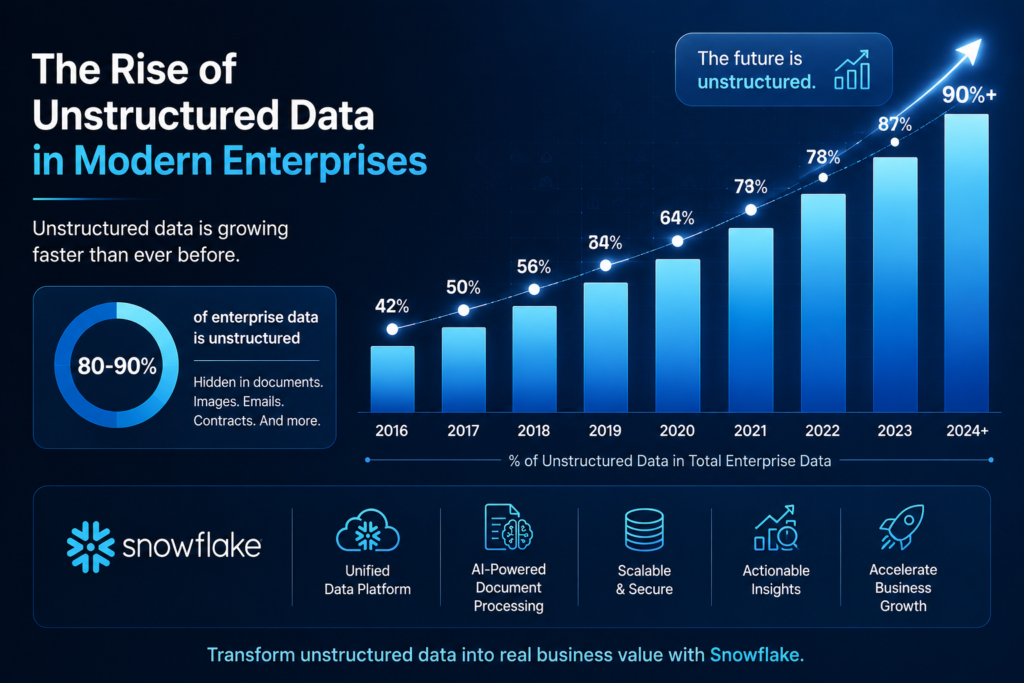
Unstructured Data Processing in Snowflake:: In today’s digital-first world, nearly 80–90% of enterprise data is unstructured, existing in the form of PDFs, invoices, contracts, emails, images, presentations, scanned documents, customer support tickets, and multimedia files. While organizations have traditionally focused on structured databases, the real business value often lies hidden within these unstructured documents.
Modern enterprises require a platform that not only stores unstructured data but also analyzes, classifies, extracts, and transforms it into actionable insights. This is where Snowflake has emerged as a game-changer.
With capabilities such as Snowpark, Snowflake Cortex AI, Document AI, External Stages, and Native Apps, Snowflake enables organizations to process millions of documents efficiently while integrating AI directly into their data platform.
In this blog, we’ll explore how Snowflake simplifies unstructured data management and intelligent document processing, making AI-powered analytics accessible to businesses of all sizes.
What is Unstructured Data?
Unstructured Data Processing in Snowflake: Unstructured data refers to information that does not follow a predefined schema or tabular format. Unlike relational databases, this data comes in multiple formats and often requires AI or machine learning for interpretation.
Common examples include:
- PDF documents
- Contracts and legal agreements
- Medical reports
- Scanned invoices
- Emails
- Images
- Audio and video files
- PowerPoint presentations
- Word documents
- Customer feedback and chat conversations
Organizations generate terabytes of unstructured data every day, making efficient processing a critical business need.
Why Unstructured Data is Critical for Businesses
Unstructured Data Processing in Snowflake: Although unstructured data represents the majority of enterprise information, many organizations struggle to extract meaningful insights from it.
Business challenges include:
- Manual document processing
- Slow invoice approvals
- Contract review delays
- Poor search capabilities
- Compliance risks
- Duplicate information
- High operational costs
By leveraging Snowflake’s AI capabilities, businesses can automate these repetitive processes while improving accuracy and decision-making.
How Snowflake Handles Unstructured Data
Snowflake extends beyond traditional data warehousing by supporting unstructured data as a first-class citizen.
Snowflake Architecture for Intelligent Document Processing
Documents
PDFs • Images • EmailsStages
Internal / ExternalStorage
Snowflake LayerDocument AI
Snowpark + OCRCortex AI
LLMs • MLInsights
Structured DataThis architecture enables organizations to process documents without moving data across multiple systems, reducing complexity and improving security.
Key Snowflake Features for Document Processing
Unstructured Data Processing in Snowflake:
1. Snowflake Internal & External Stages
Snowflake supports both Internal Stages and External Stages, allowing organizations to store documents securely.
Supported cloud storage includes:
- Amazon S3
- Microsoft Azure Blob Storage
- Google Cloud Storage
Files can be loaded directly into Snowflake for downstream AI processing.
2. Snowpark
Snowpark enables developers to process unstructured data using familiar programming languages such as Python, Java, and Scala.
With Snowpark, organizations can:
- Read PDF files
- Process images
- Perform OCR
- Clean extracted text
- Apply NLP models
- Build custom AI pipelines
This eliminates the need for separate data engineering platforms.
3. Snowflake Document AI
Snowflake Document AI simplifies document understanding by automatically extracting structured information from business documents.
Examples include:
- Invoice Number
- Purchase Order
- Customer Name
- Total Amount
- Vendor Details
- Tax Information
- Dates
- Line Items
Instead of manually reviewing thousands of invoices, Document AI converts them into structured datasets within minutes.
4. Snowflake Cortex AI
Snowflake Cortex brings Generative AI directly into the Snowflake ecosystem.
Organizations can:
- Summarize documents
- Translate content
- Generate document embeddings
- Perform semantic search
- Classify documents
- Build Retrieval-Augmented Generation (RAG) applications
- Ask natural language questions about enterprise documents
This dramatically improves knowledge discovery across large document repositories.
Real-World Use Cases of Snowflake Document AI
Unstructured Data Processing in Snowflake:
Financial Services
Banks process millions of documents every year.
Snowflake helps automate:
- Loan applications
- KYC verification
- Bank statements
- Tax documents
- Compliance reporting
- Fraud detection
Healthcare
Healthcare organizations use Snowflake to analyze:
- Medical reports
- Lab results
- Patient histories
- Insurance claims
- Prescription documents
AI reduces administrative effort while improving patient care and regulatory compliance.
Insurance
Insurance companies automate:
- Claims processing
- Policy verification
- Damage assessment
- Customer correspondence
- Risk evaluation
Document AI significantly reduces claim processing times.
Retail & E-Commerce
Retail businesses analyze:
- Supplier invoices
- Product catalogs
- Customer reviews
- Warranty documents
- Purchase orders
AI-powered document processing helps improve inventory planning and supplier management.
Legal Industry
Law firms and corporate legal teams use Snowflake to:
- Search contracts
- Extract legal clauses
- Identify renewal dates
- Detect compliance issues
- Summarize lengthy agreements
This saves countless hours of manual legal review.
Benefits of Unstructured Data Processing in Snowflake
Unstructured Data Processing in Snowflake: Organizations adopting Snowflake for unstructured data management experience several advantages:
Faster Processing
AI automates document extraction in seconds instead of hours.
Lower Costs
Reduced manual effort translates into significant operational savings.
Improved Accuracy
Machine learning minimizes human errors during data extraction.
Better Compliance
Centralized document storage supports governance, auditing, and regulatory requirements.
AI-Powered Search
Employees can locate relevant information using natural language rather than manually browsing folders.
Unified Data Platform
Structured and unstructured data coexist within a single secure environment, eliminating data silos.
Best Practices
To maximize the value of Snowflake’s document processing capabilities:
- Store raw documents in secure stages.
- Use Snowpark for scalable preprocessing.
- Implement Document AI for structured extraction.
- Leverage Cortex AI for summarization and semantic search.
- Apply role-based access control (RBAC) to protect sensitive documents.
- Monitor processing pipelines with automated alerts.
- Optimize storage using lifecycle management and compression.
- Regularly validate AI outputs for critical business processes.
These practices help organizations build reliable, scalable, and secure document intelligence solutions.
The Future of Enterprise Document Intelligence with Snowflake
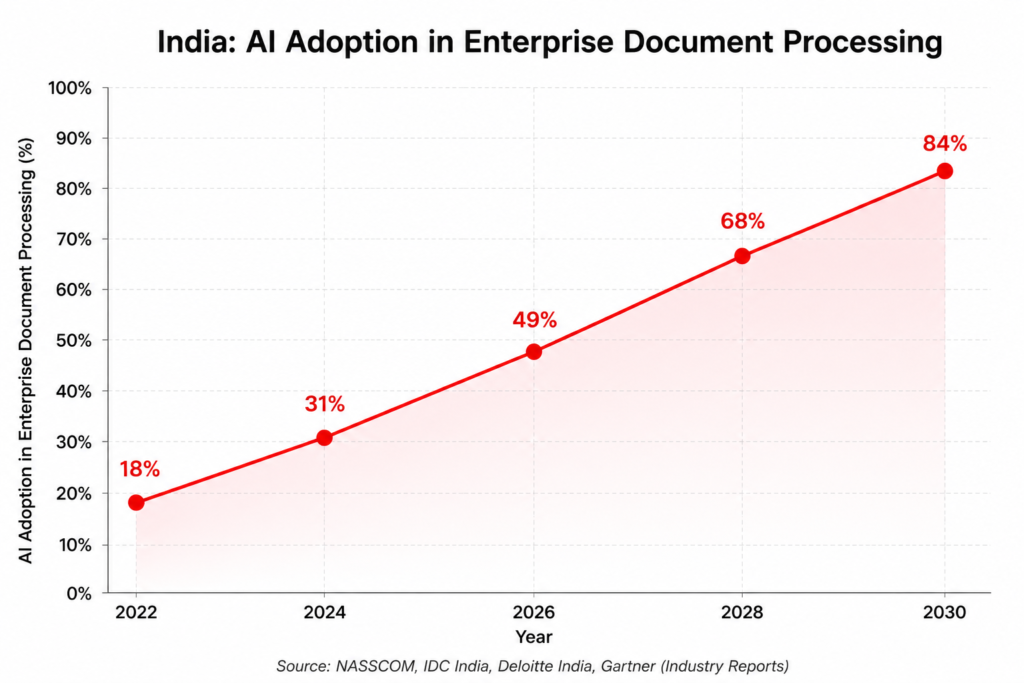
Unstructured Data Processing in Snowflake: The future of document processing is shifting from simple Optical Character Recognition (OCR) to intelligent AI agents capable of understanding context, answering questions, and automating workflows.
Snowflake is at the forefront of this transformation by integrating data warehousing, machine learning, and Generative AI into a unified platform. Businesses can now build solutions that not only extract information but also generate insights, recommend actions, and accelerate decision-making.
As enterprises continue to embrace AI-driven digital transformation, platforms like Snowflake will become central to managing both structured and unstructured data at scale.
Conclusion
Unstructured Data Processing in Snowflake: Unstructured data represents one of the largest untapped assets within modern organizations. From invoices and contracts to medical records and customer communications, extracting value from these documents has historically been complex and time-consuming.
Unstructured Data Processing in Snowflake: Snowflake changes this paradigm by combining secure cloud storage, scalable data processing, Document AI, Snowpark, and Cortex AI into a single ecosystem. This enables organizations to automate document workflows, improve operational efficiency, reduce costs, and unlock actionable insights from previously inaccessible information.
Unstructured Data Processing in Snowflake: For businesses looking to modernize their data strategy, mastering unstructured data and document processing in Snowflake is no longer optional, it’s a strategic advantage that drives innovation, agility, and smarter decision-making in the age of AI.
Frequently Asked Questions (FAQs)
Find answers to the most common questions about unstructured data processing, Snowpark, Document AI, and Snowflake Cortex AI.
What is unstructured data in Snowflake?
Unstructured data in Snowflake includes files such as PDFs, images, emails, contracts, videos, audio files, and scanned documents that do not follow a predefined table structure. Snowflake enables organizations to securely store, process, and analyze these files using AI-powered capabilities.
How does Snowflake Document AI work?
Snowflake Document AI automatically extracts structured information from business documents such as invoices, purchase orders, contracts, and forms using Optical Character Recognition (OCR), machine learning, and Generative AI.
What is Snowpark used for?
Snowpark enables developers to build scalable data engineering, machine learning, and AI applications using Python, Java, or Scala directly inside Snowflake without moving data outside the platform.
What is Snowflake Cortex AI?
Snowflake Cortex AI provides built-in Generative AI capabilities, allowing businesses to summarize documents, classify content, perform semantic search, generate embeddings, and build Retrieval-Augmented Generation (RAG) applications.
Can Snowflake process PDF documents?
Yes. Snowflake supports processing PDF documents through Snowpark, Document AI, and Cortex AI, enabling organizations to extract text, classify documents, and generate actionable insights.
What are the benefits of document processing in Snowflake?
Snowflake improves document processing by automating data extraction, reducing manual effort, enhancing accuracy, supporting compliance, enabling AI-powered search, and integrating structured and unstructured data within a unified platform.
Which industries use Snowflake Document AI?
Industries such as banking, healthcare, insurance, retail, manufacturing, logistics, government, and legal services use Snowflake Document AI to automate document workflows and improve operational efficiency.
Why is unstructured data important for enterprises?
More than 80% of enterprise data is unstructured. Analyzing this information enables organizations to improve customer experiences, automate workflows, gain business insights, reduce operational costs, and make faster data-driven decisions.
Master the Future of Data Architecture
Explore SkillMove’s enterprise program built to match modern engineering demand.
Snowflake Data Engineering Fellowship
Become an industry-ready Data Engineer by mastering Snowflake, SQL, Snowpark, Cortex AI, Data Warehousing, and ETL Pipelines.
- 📅 Duration : 3 Months
- ☁️ Snowflake Cloud & Snowpark
- 💼 Live Cloud Data Projects
- 🏆 Career & Interview Assistance
- 🎓 Industry Certifications