5 Snowflake Use Cases That Show How Data Drives Real Business Decisions

Short Summery:
5 Snowflake Use Cases: Data alone does not grow a business. The ability to use data to make faster and smarter decisions does.
From personalized marketing and retail demand forecasting to fraud detection, healthcare analytics, and executive dashboards, Snowflake use cases are helping businesses transform raw data into real business value.
In this guide, we explore five practical Snowflake use cases and explain how organizations use Snowflake to centralize data, improve analytics, support AI, and make better decisions.
Introduction : Every Business Has Data. But Who Actually Understands It?
5 Snowflake Use Cases: Almost every business collects data.
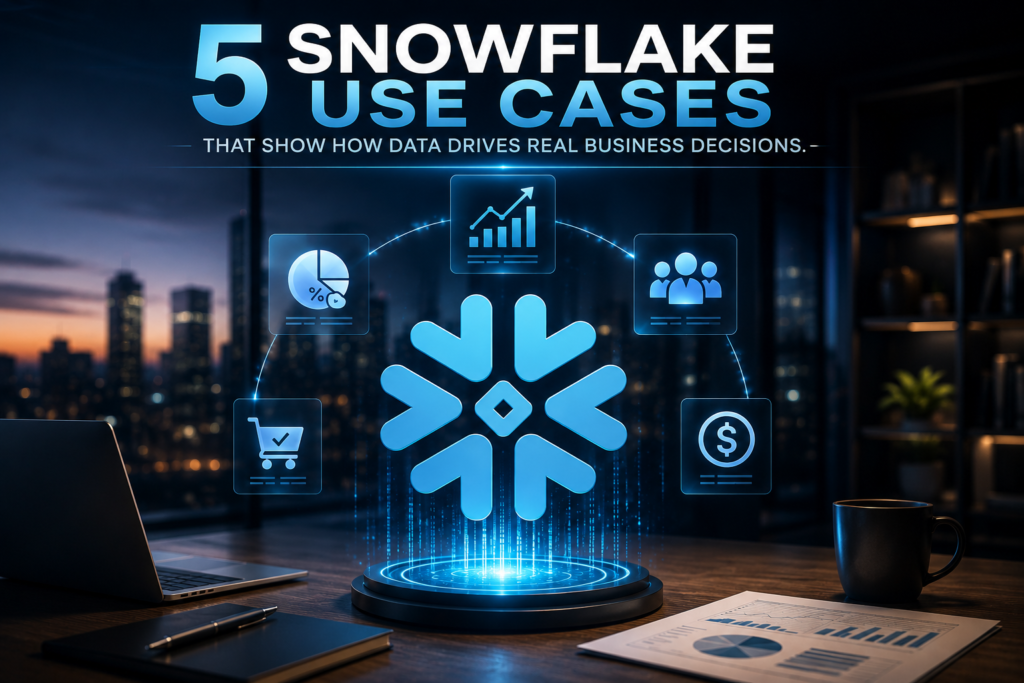
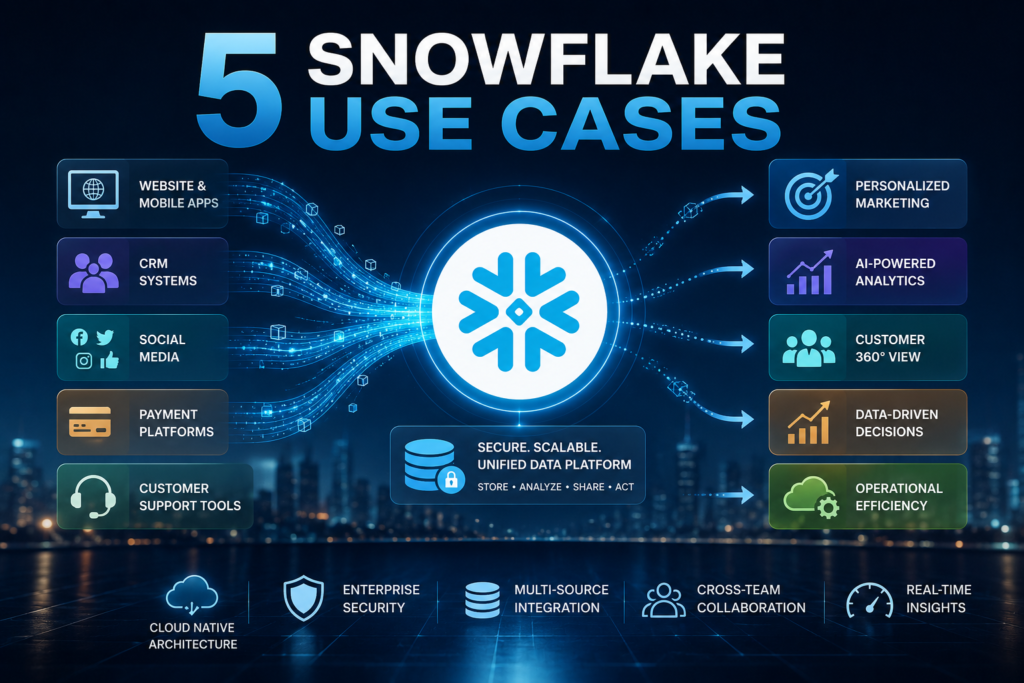
Customer information comes from websites, mobile applications, CRM systems, social media, payment platforms, and customer support tools. However, the real challenge is not collecting data.
The real challenge is connecting that data and turning it into useful insights.
A marketing team may have customer data in a CRM, website analytics in another platform, advertising data in a third-party tool, and sales data in a completely different system.
As a result, teams often work with incomplete information.
This is where modern cloud data platforms like Snowflake become important.
Snowflake helps businesses bring data from multiple sources into a secure, scalable environment where teams can store, analyze, share, and use data for business decisions.
From personalized marketing to AI-powered analytics, there are several powerful Snowflake use cases across different industries.
Let’s explore five of the most important examples.
What Is Snowflake?
5 Snowflake Use Cases:Snowflake is a cloud-based data platform designed to help organizations store, manage, process, and analyze large volumes of data.
Unlike traditional databases that often require significant infrastructure management, Snowflake uses a cloud-native architecture that allows businesses to scale their storage and computing resources based on their requirements.
Businesses can use Snowflake to:
- Store structured and semi-structured data
- Combine data from multiple sources
- Run analytics and business intelligence
- Support AI and machine learning workflows
- Share data securely
- Build data applications
- Create real-time and predictive dashboards
Because of these capabilities, Snowflake has become an important platform for organizations building modern data and AI ecosystems.
Why Are Businesses Using Snowflake?
Before exploring individual Snowflake use cases, it is important to understand the problem businesses are trying to solve.
Imagine a retail company where:
- Sales data exists in one system
- Website analytics exist in another
- Customer information is stored in a CRM
- Inventory data is managed separately
- Marketing data is stored in advertising platforms
Without a centralized data platform, teams may not have a complete view of the business.
Snowflake helps bring this data together.
This allows organizations to create a more reliable source of truth and make decisions based on connected information rather than isolated data.
Now let’s look at some practical Snowflake use cases.
Customer 360 and Personalized Marketing
One of the most popular Snowflake use cases is creating a unified view of the customer.
Imagine a customer who:
- Visits an e-commerce website
- Views a product
- Adds the product to the cart
- Leaves without completing the purchase
- Receives a personalized advertisement the next day
This type of experience depends on connecting customer data across different platforms.
The Challenge
Customer data is often distributed across:
- CRM systems
- Websites
- Mobile applications
- Social media platforms
- Email marketing tools
- Customer support systems
- Advertising platforms
When this data is disconnected, marketing teams may have difficulty understanding customer behavior.
How This Snowflake Use Case Works
5 Snowflake Use Cases: Snowflake can bring data from multiple sources into a centralized data environment.
Organizations can then create a unified customer profile that combines:
- Purchase history
- Website behavior
- Product preferences
- Campaign interactions
- Customer support activity
- Demographic information
Marketing teams can use this data to create more accurate customer segments and deliver personalized campaigns.
Business Impact
5 Snowflake Use Cases: This Snowflake use case can help organizations achieve:
- Higher customer engagement
- Better conversion rates
- Improved customer retention
- More effective marketing campaigns
- Better return on advertising investment
Instead of asking, “Who is our customer?”, businesses can use connected data to understand what customers actually do.
Retail Demand Forecasting
Another important Snowflake use case is retail demand forecasting.
Every retailer faces the challenge of balancing inventory.
Too little inventory can lead to stockouts and lost sales.
Too much inventory can increase storage costs and create unsold products.
The Challenge
5 Snowflake Use Cases:
Retail businesses may need to analyze:
- Historical sales
- Current inventory
- Seasonal trends
- Customer behavior
- Weather patterns
- Promotions
- Regional demand
When this data exists across multiple systems, accurate demand forecasting becomes difficult.
How This Snowflake Use Case Works
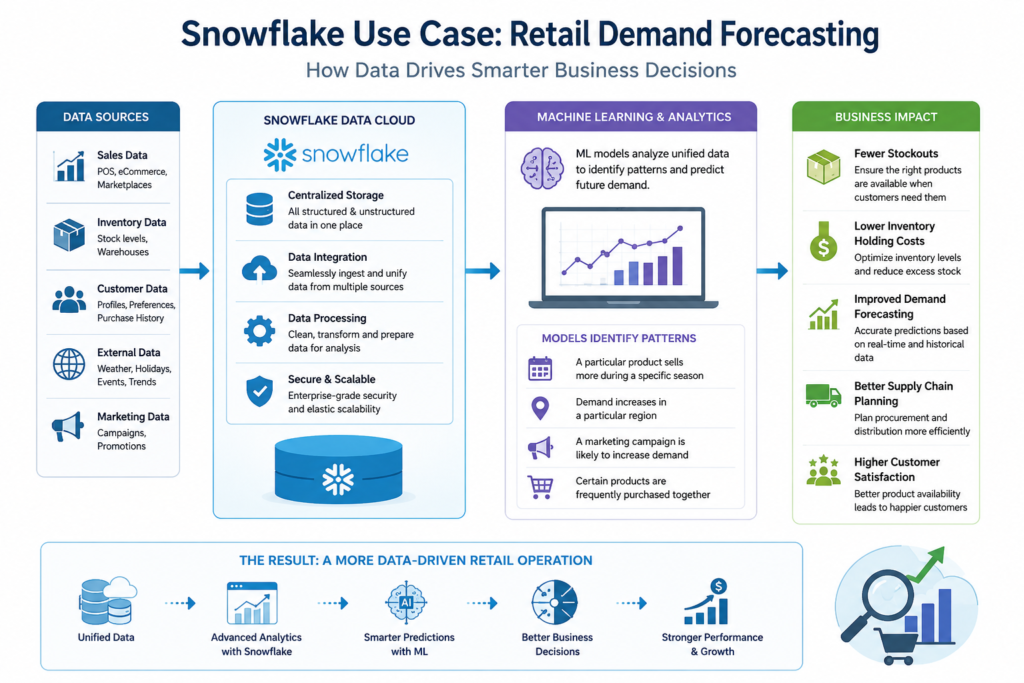
Snowflake can centralize sales, inventory, customer, and external data.
Machine learning models can then analyze this information to identify patterns and forecast future demand.
For example, a retailer may discover that:
- A particular product sells more during a specific season
- Demand increases in a particular region
- A marketing campaign is likely to increase product demand
- Certain products are frequently purchased together
Businesses can use these insights to improve inventory planning.
Business Impact
This Snowflake use case can help retailers achieve:
- Fewer stockouts
- Lower inventory holding costs
- Improved demand forecasting
- Better supply chain planning
- Higher customer satisfaction
The result is a more data-driven retail operation.
Financial Fraud Detection
Financial fraud is another powerful example of Snowflake use cases.
Banks, payment companies, and fintech organizations process millions of transactions every day.
The challenge is identifying suspicious behavior among legitimate transactions.
The Challenge
5 Snowflake Use Cases: A fraudulent transaction may appear normal at first.
However, when it is analyzed alongside other transactions, a suspicious pattern may become visible.
For example:
- Multiple transactions from unusual locations
- Sudden changes in spending behavior
- Multiple failed login attempts
- Unusual payment activity
- Transactions that do not match previous customer behavior
Manually identifying these patterns is almost impossible at scale.
How This Snowflake Use Case Works
Snowflake can process and analyze large volumes of transaction data from multiple sources.
Organizations can combine:
- Payment data
- Customer profiles
- Historical transactions
- Device information
- Location data
- Account activity
AI and machine learning models can then help identify unusual patterns.
Business Impact
This Snowflake use case can support:
- Faster fraud detection
- Reduced financial losses
- Improved customer protection
- Faster investigation
- Better regulatory reporting
For financial organizations, the ability to analyze large volumes of data quickly can make a significant difference.
Healthcare Analytics
5 Snowflake Use Cases: Healthcare is another industry where data plays a critical role.
Hospitals and healthcare organizations generate large volumes of information every day.
However, this information is often stored across different systems.
The Challenge
Healthcare organizations may have data in:
- Electronic Health Records
- Laboratory systems
- Pharmacy systems
- Billing platforms
- Medical devices
- Hospital management systems
When this information is disconnected, healthcare professionals and administrators may not have a complete view of the situation.
How This Snowflake Use Case Works
5 Snowflake Use Cases: Snowflake can help organizations bring different types of healthcare data into a centralized environment.
This can support analytics related to:
- Patient outcomes
- Hospital resource utilization
- Treatment planning
- Operational performance
- Population health
Organizations can use data analytics to identify patterns and support better decision-making.
Business Impact
This Snowflake use case can contribute to:
- Better patient outcomes
- Smarter treatment planning
- Improved resource management
- Reduced operational costs
- Evidence-based decision-making
The goal is not simply to collect more healthcare data.
The goal is to make the right data available at the right time.
Executive Business Intelligence
5 Snowflake Use Cases: Executives need accurate information to make important business decisions.
However, many organizations still depend on outdated reports and manually created spreadsheets.
This is where executive business intelligence becomes another important Snowflake use case.
The Challenge
Data may be divided between:
- Sales
- Marketing
- Finance
- Operations
- Customer service
- Human resources
Leadership teams may have to wait for different departments to prepare reports before they can understand the current state of the business.
By the time the report is ready, the data may already be outdated.
How This Snowflake Use Case Works
5 Snowflake Use Cases: Snowflake can centralize enterprise data and connect with business intelligence tools such as:
- Tableau
- Power BI
- Looker
Organizations can then create dashboards that display important business metrics.
For example, leadership can monitor:
- Revenue
- Sales performance
- Marketing ROI
- Customer acquisition
- Customer retention
- Operational performance
With predictive analytics, businesses can also move beyond understanding what happened and start identifying what may happen next.
Business Impact
This Snowflake use case can help organizations achieve:
- Faster decision-making
- Real-time performance visibility
- Better strategic planning
- Improved business agility
A business that understands its data faster can often respond to market changes faster.
Why Organizations Keep Choosing Snowflake
Across these Snowflake use cases, several common advantages appear.
Organizations choose Snowflake because it can help them create:
A Single Source of Truth
Data from multiple departments and platforms can be brought together into a centralized environment.
Scalable Cloud Architecture
Businesses can scale their data infrastructure as their requirements grow.
Advanced Analytics
Teams can use centralized data for reporting, analytics, and predictive insights.
Secure Data Sharing
Organizations can securely share data across teams, departments, and business partners.
AI and Machine Learning Integration
Snowflake can support modern AI and machine learning workflows.
Support for Multiple Data Types
Businesses can work with structured, semi-structured, and unstructured data.
These capabilities make Snowflake valuable for organizations that want to build modern data-driven operations.
Why Snowflake Is Important for AI and Data Careers
The growth of these Snowflake use cases is also creating new career opportunities.
Organizations need professionals who can:
- Build data pipelines
- Manage cloud data platforms
- Write SQL queries
- Develop data models
- Create business intelligence dashboards
- Work with machine learning workflows
- Use AI tools with enterprise data
Some of the career opportunities include:
- Snowflake Data Engineer
- Data Engineer
- Data Analyst
- Business Intelligence Developer
- Cloud Data Engineer
- Analytics Engineer
- Data Architect
The future of data careers is also becoming increasingly connected to artificial intelligence.
Professionals who understand Snowflake alongside AI tools and modern data workflows can develop a valuable combination of skills.
Learn Snowflake the Way Companies Actually Hire For It with SkillMove
Understanding Snowflake use cases is the first step.
Building them in real-world projects is the next.
SkillMove’s Snowflake Master Training Program is designed to help learners develop practical, industry-relevant skills in modern data technologies.
The program focuses on more than just theoretical concepts.
Learners can explore:
- Snowflake fundamentals
- SQL
- Data engineering concepts
- Real-world Snowflake projects
- Data pipelines
- Business intelligence
- Snowflake Cortex AI
- Generative AI tools
- Modern AI-powered data workflows
What makes the program different is its focus on industry requirements.
SkillMove was founded by Sreenivas G, with recruitment experience through its sister company LN Teks, which actively works with organizations and hiring requirements.
This helps create a curriculum focused on the skills companies are actually looking for.
What Makes SkillMove Different?
Recruiter-Built Curriculum
The learning approach is designed around real hiring requirements rather than only theoretical concepts.
AI-Native Learning
The program combines Snowflake with modern AI tools and workflows, including Snowflake Cortex AI and Generative AI technologies.
Practical Learning
Learners work toward understanding how Snowflake is used in real business environments.
Career-Focused Training
The objective is to help learners build practical, job-relevant skills for the modern data industry.
Final Thoughts
The most important lesson from these Snowflake use cases is simple:
Data has value only when businesses can use it to make better decisions.
Marketing teams use data to understand customers.
Retailers use it to forecast demand.
Banks use it to detect fraud.
Healthcare organizations use it to improve patient insights.
Executives use it to understand business performance.
Behind all of these use cases are professionals who know how to collect, organize, analyze, and transform data into meaningful insights.
As businesses continue investing in cloud data platforms and artificial intelligence, Snowflake skills are becoming increasingly valuable.
If you want to build a career in data, analytics, cloud technologies, or AI, learning Snowflake can be an important step toward developing the skills modern companies are looking for.
Learn Snowflake. Build real projects. Work with modern AI. Build the skills companies need.
Explore SkillMove’s Snowflake Master Training Program and take the next step toward a career in the data and AI industry.
Frequently Asked Questions About Snowflake Use Cases
01 What are the most common Snowflake use cases?
The most common Snowflake use cases include customer 360, personalized marketing, retail demand forecasting, fraud detection, healthcare analytics, executive business intelligence, and AI-powered data analysis.
02 What is Snowflake mainly used for?
Snowflake is mainly used to store, process, analyze, and share large volumes of data in a scalable cloud-based environment.
03 Which industries use Snowflake?
Industries including retail, banking, fintech, healthcare, marketing, technology, manufacturing, and enterprise businesses use Snowflake for data analytics and business intelligence.
04 Is Snowflake only useful for large companies?
No. Snowflake can be used by both large enterprises and growing businesses. Its cloud-based architecture allows organizations to scale according to their data and computing requirements.
05 Is Snowflake a database?
Snowflake is more than a traditional database. It is a cloud data platform designed for data warehousing, analytics, data engineering, data sharing, and modern AI and machine learning workflows.
06 Can Snowflake support AI and machine learning?
Yes. Snowflake supports modern AI and machine learning workflows, including capabilities such as Snowflake Cortex AI, which allows organizations to work with AI capabilities alongside their enterprise data.
07 Do I need coding skills to learn Snowflake?
SQL is one of the most important skills for working with Snowflake. Depending on the role, professionals may also need Python, data engineering, cloud, and analytics skills.
08 What jobs can I get after learning Snowflake?
Professionals with Snowflake skills can explore careers such as Data Engineer, Snowflake Developer, Data Analyst, BI Developer, Analytics Engineer, and Cloud Data Specialist.
09 How long does it take to learn Snowflake?
The time required depends on your background and learning approach. With structured training and hands-on projects, learners can build practical Snowflake skills in a relatively short period.